Football News
The heavily jeered $250m goldmine - are hydration break ads here to stay?
That's how much extra TV advertising some football fans around the world are watching during mandatory hydration breaks at the World Cup.
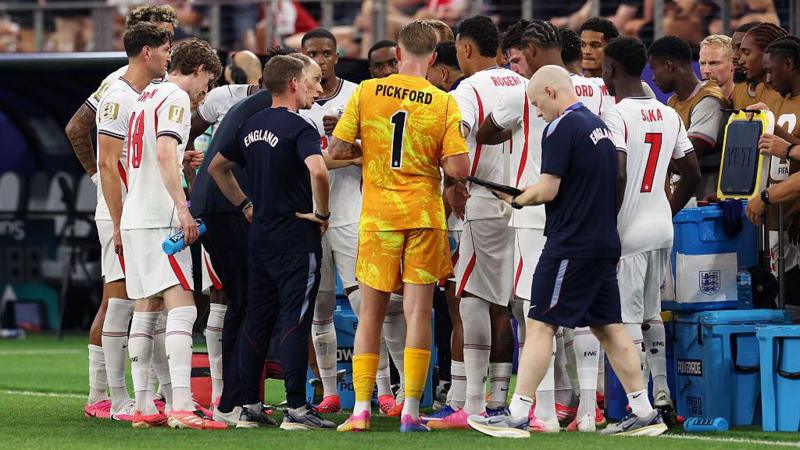
While viewers in the UK watching on BBC and ITV are seeing players refuel and hearing extra tactical insight from pundits, spectators elsewhere are taken away from the football to see companies selling their products.
The ads are allowed to begin 20 seconds after the referee blows the whistle for the three-minute pause midway through each half, and must end 30 seconds before the actions starts again.
That works out as a potential eight extra 30-second ad slots per match for each broadcaster in each country - 832 between the start and end of the competition.
Experts have told BBC Sport that an average 30-second World Cup ad slot on Fox Sports costs between $200,000 (£152,000) and $300,000 (£227,000), rising to $750,000 (£567,000) during USA matches and the final stages.
That means advertising during hydration breaks is likely to generate more than $250m (£189m) in the USA alone.
The breaks have brought heavy criticism from managers and players, while drawing loud jeers from the supporters at almost every venue.
But, in which countries are the ads being shown, how do they work, and what could it mean for the future of football?
But they have been widely derided as unnecessary momentum-killers by fans, pundits, players and managers, and are having a tactical impact on matches.
Fans in the UK have been protected from ads during hydration breaks because the BBC does not use advertising, and ITV's ability to show ads during play is restricted by Ofcom regulations governing how many adverts can be used in a 60-minute period. If ITV used slots during mid-match breaks, they would have fewer available at half-time, for example.
But elsewhere broadcasters have the ability to choose how to use the breaks, and most have used them as an opportunity to bring in extra money from advertising, whether by cutting away to a full commercial break or showing ads in split screen.
Fox Sports, the US broadcaster, has been using the maximum amount of advertising time it can during the pauses and displaying them full screen.
It has also been introducing the ad break itself as "sponsored by" a brand, and with Fifa sponsor Coca Cola providing branded drinks for players, the advertising US viewers are faced with during hydration breaks is effectively three-fold.
"Amercians have been used to in-play ads for 40, 50 years, so culturally this fits right in," says Rob di Gisi, lecturer in sport management at the University of Pennsylvania's Wharton School.
"There is very little pushback here. Any changes which make games more Americanised will be embraced without people noticing."
Fellow US broadcaster Telemundo, which shows matches in Spanish and is aimed at Latino Americans, is one of the few broadcasters which has decided not to show ads during the breaks.
During Canada's opening match last week, its commentator said: "We prefer the old school way. We should be able to see what the players do.
"We show fans, people enjoying themselves, not the corporate direction of football."
BBC Sport has contacted Fox Sports and Telemundo for comment.
In other big markets around the world ads are being used too, including in Mexico, Canada, France, Germany, Italy, Spain, China, Japan, India, Australia, the Middle East and Sub-Saharan Africa.
The broadcasters in those territories will not be able to charge prices as high as Fox Sports, and not all are running them for the maximum duration allowed, but the total amount accrued will be huge.
"When you start scaling that up over all the rest of the countries, it's probably a billion dollars (£756m) from hydration break ads across the globe," Di Gisi adds.
Having eyeballs on products during in-game breaks doesn't necessarily guarantee success, however.
"Will advertisers in the hydration break be met with enough discontent that it negates the value of the advertising?" says T. Bettina Cornwell, head of marketing at the University of Oregon.
"It is the case that when brands violate the expected experience, in this case the flow of the game, fans can react negatively."
The broadcasters in each territory act independently when they sell advertising slots, meaning Fifa does not directly gain financially.
But the extra income makes purchasing rights to show the World Cup more valuable to broadcasters, meaning Fifa can theoretically charge higher prices when negotiating over future tournaments.
"The rights for this World Cup, Fox Sports got for only $485m (£367m)," says Dennis Deninger, author of Live Sports Media: The What, How and Why of Sports Broadcasting.
"If they're making $250m (£189m) just on the hydration breaks, that rights fee is a real bargain.
"When Fifa goes into rights negotiations next time, they can say their product is worth more, because broadcasters can sell sponsorship in these hydration breaks, have more advertising, and there is the increased amount of matches, so they can charge every broadcaster in every country more money.
"There is never any going back – when there is an opportunity to make more money, nobody ever says 'let's make less money'."
The more casual football fan demographic the World Cup attracts has made introducing the ads easier.
"I think this is here to last, especially in Fifa-organised tournaments," says Thomas Peeters, professor of strategy economics at the Erasmus School of Economics.
"The World Cup is an event that attracts non-traditionalists, people tuning in who don't watch every game. A very general audience.
"There is a trend for those people to watch clips rather than entire games, so in that sense you can build in breaks yourself [and show ads to them without them caring].
"It breaks the game into shorter bits which, as we see with other forms of entertainment, helps with younger audiences who typically consume content in smaller portions."
But whether other major football competitions would take on hydration breaks for the economic benefit is doubtful.
The Premier League would be restricted in the UK by Ofcom rules and likely face a huge backlash from fans, while Uefa has sought to create clear distance between itself and Fifa on policy matters in recent months, including pledging not to use dynamic ticket pricing at Euro 2028.
"When a game is watched by diehard fans of both sides, they don't want a break after 25 minutes," Peeters adds.
"For Uefa and the Premier League this idea is less of a concern because they are in very mature markets compared to Fifa."
Source: BBC Sport · View original article ↗
This article has been sourced from an external provider and does not represent the views or opinions of AccaMate.