AccaMate logo
FIFA World Cup 2026 logo

FIFA World Cup

2026 — The Tournament Of A Lifetime

11 June – 19 July 2026

Host nations

Canada flagCanada
Mexico flagMexico
USA flagUSA

Countdown to World Cup

--Days
:
--Hrs
:
--Mins
:
--Secs

World Cup News

The latest stories, squad announcements, build-up coverage and tournament analysis — direct from FIFA.

Players who turned World Cup heroics into big transfers

World Cup News

Players who turned World Cup heroics into big transfers

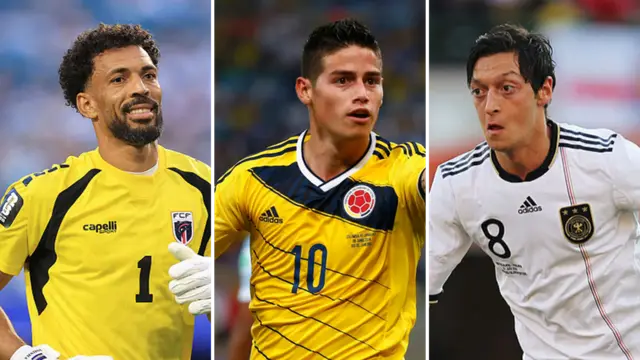
141 Comments The World Cup is football's biggest stage, filled with goals, drama and unforgettable moments - but it can also prove to be the ultimate shop window. World Cup heroics have transformed players' lives in the past, and Vozinha's recent move to Chilean side Colo-Colo after an impressive tournament with Cape Verde is the latest reminder that the competition still has the power to change careers. At the age of 40, the goalkeeper's journey from the Portuguese second division to Chile's biggest club may be unique, but he is not the first to get a big move after starring on the global stage. Here are some of the players whose standout performances at the World Cup earned them a big move. Similar to Vozinha, Marc-Vivien Foe was an unknown name before the 1994 World Cup. Despite Cameroon's disappointing World Cup campaign in the USA, compared to their historic run in 1990, Foe emerged as one of the team's best performers during his debut tournament. A standout game against Brazil caught attention, which then led to a free transfer from Cameroon's Canon Yaounde to French side Lens. Foe spent four years at Lens and helped them achieve their first league title in the 1997-98 season. He also played for West Ham United, Manchester City and Lyon, where he won the French League Cup and Lyon's first Ligue 1 title in 2002. Foe tragically passed away in June 2003 after he collapsed during a Confederations Cup semi-final against Colombia. Gilberto Silva's first appearance at a World Cup came in 2002, when the tournament was hosted in South Korea and Japan. The 25-year-old, who played in Brazil's top division for Atletico Miniero, returned home as a World Cup winner who played every minute of every game for Luiz Felipe Scolari's team. Silva was only brought into the starting XI because Brazil captain Emerson was ruled out by injury. But, after playing a key role in Brazil's triumph, the midfielder earned a move to Premier League champions Arsenal. Nicknamed 'The Invisible Wall', the defensive midfielder joined the Gunners from Atletico Mineiro for about £4.5m. During his six years in north London, Silva won two FA Cups and played a key role in the famous 2003-04 Invincibles side that went unbeaten to claim the Premier League title. At the age of 22, Javier Mascherano announced himself on the global stage at the 2006 World Cup, where he helped Argentina reach the quarter-finals. His performances for both his club back in Brazil and at the World Cup drew the attention of European clubs. Mascherano initially expressed his desire to remain at Corinthians and help the club in their relegation battle. However, he soon made the move to West Ham United in the summer of 2006 alongside his Argentina team-mate Carlos Tevez, who also impressed at the World Cup in Germany. Mascherano had a brief spell with the Hammers until the beginning of 2007, leaving to join Liverpool where he featured in their 2007 Champions League final defeat by AC Milan. Mascherano then played for Barcelona from 2010, winning the Champions League twice and being part of squads that won La Liga on five occasions. At the age of just 21, Mesut Ozil emerged as one of the world's most exciting young players after he helped Germany finish third at the 2010 World Cup. After registering four goals and four assists in seven games, Ozil was able to show off his quality and prove he was a standout performer. Big clubs took note, and by August 2010, Ozil switched Werder Bremen for Real Madrid, for a fee of about 15m euros (£12.4m). Copa del Rey, La Liga and Spanish Super Cup titles were to follow during his three year stay in Madrid, before becoming Arsenal's record signing for £42.4m in 2013. James Rodriguez became one of the stars of the 2014 World Cup, scoring six goals for Colombia and winning the Golden Boot after a memorable run to the quarter-finals. His excellent performances, including his famous volley against Uruguay, earned him a spot in Fifa's team of the tournament. The volley against Uruguay was later voted as the best goal in the tournament by more than four million people on Fifa's website and won the Fifa Puskas Award for the best goal of the year. Real Madrid decided to sign Rodriguez from Monaco for about 75m euros (£71m) after the tournament - a move that led to him winning multiple trophies with Los Blancos, including two Champions Leagues. Vozinha became a cult hero when Cape Verde claimed their first World Cup point against Spain in the group stage and his social media fame has exploded from 50,000 Instagram followers to nearly 30 million. After helping his team reach the knockout stages, taking finalists Argentina to extra time in the last 32, Vozinha was named in Fifa's team of the tournament and even had a newly discovered species of sea slug named after him. Vozinha's career has taken him to Slovakia, Angola, Moldova, Cyprus and, until recently, Portuguese second division side Chaves, but he has always believed himself to be a "big club player". Joining Colo Colo, the most successful team in the Primera Division (34 titles) and Copa Chile (14), is his career "highlight". Gheorghe Hagi - Brescia to Barcelona (1994) Dejan Stankovic - Red Star Belgrade to Lazio (1998) Carlos Salcido - Guadalajara to PSV Eindhoven (2006) Nicolas Otamendi - Velez Sarsfield to Porto (2010) Edinson Cavani - Palermo to Napoli (2010) Sami Khedira - Stuttgart to Real Madrid (2010) Keylor Navas - Levante to Real Madrid (2014) Enner Valencia - Pachuca to West Ham United (2014) Enzo Fernandez - Benfica to Chelsea (2022) Vozinha to join Chilean club after World Cup heroics Vozinha granted shirt name exemption by Chile FA

FIFA.com06 Aug 2026
Fifa scraps controversial World Cup investment plan

World Cup News

Fifa scraps controversial World Cup investment plan

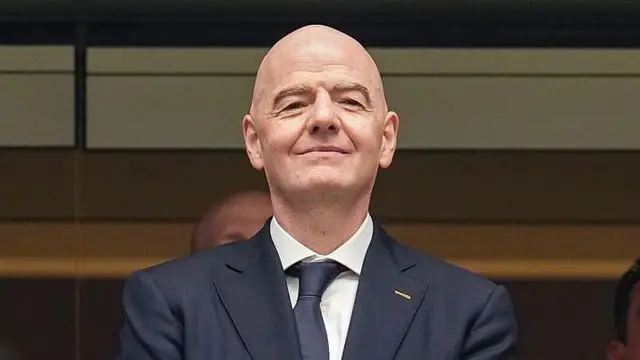
Infantino said it had become clear the project had "created divisions" that are "no longer in the interest" of its original objective. The Swiss official added: "As a result, this proposal will not proceed." Infantino had offered Fifa's 211 member associations $40m (£30m) if they backed a proposal for private investment in its tournaments, including the men's and women's World Cups. However, Uefa - which governs European football - responded by voting to boycott World Cups if the plans went ahead, and other governing bodies also voiced their opposition. Infantino on the brink? Who might replace him if he goes? Carlos Cordeiro - Infantino's senior adviser on global strategy and governance - resigned over the matter, saying the proposal was "a bad deal for football" and would "mortgage football's future". That came after two other major confederations spoke out against the plans. Concacaf, which governs football in North, Central America and the Caribbean - and hosted this summer's World Cup - said its members "rejected" the proposal, with sources saying the vast majority of associations from the region are losing, or have lost, faith in Infantino. The Asian Football Confederation (AFC) said it stood in "solidarity" with Uefa and Concacaf, while UK Prime Minister Andy Burnham said Infantino was "the wrong man" to lead Fifa. It means Infantino is now under immense pressure as he seeks re-election for a fourth term as president at the Fifa Congress in March. "Our purpose has always been - and will always be - to unite and improve," the 56-year-old added in a statement. "Moving forward, my intent is to bring all interested parties back together in the coming days and weeks in the spirit of shared interest in our game." AFC president Sheikh Salman bin Ebrahim Al Khalifa welcomed the withdrawal of the plan. "The future of global football must always be shaped through proper consultation, collective dialogue and respect for the established governance structures of our game," he said. Despite rejections from Uefa and Concacaf, Fifa initially vowed to continue with its proposals on Friday, saying "nobody is selling football". However, Infantino would have needed the backing of a majority of member associations to pass the plans - meaning 106 of its 211 members needed to vote in favour. That became unlikely when the AFC joined Uefa and Concacaf in opposing the plans. If all member associations backed the stance of their governing body, that would have meant 136 nations voting against Infantino's plan. Governing bodies in Africa (CAF) and Oceania (OFC) had said they would discuss Fifa's plan in August. Conmebol - South American football's governing body - said it had asked Fifa for "additional information and clarifications" regarding the "scope, structure, governance and possible effects" of the proposals. It said it would "invite third parties to make minority, non-controlling investments" in a new subsidiary - Fifa Forward Enterprise (FFE). Infantino set a deadline of 19 September for football federations to accept his plans if they wanted to access an initial $20m (£15m). A 25-page document created by investment bank JP Morgan laid out how Fifa's tournaments would expand to hit an estimated increased payout of 24m euros (£20.5m) per member association in the 2035-2039 cycle. It mentioned "new business initiatives" and "attracting top talent with incentive-driven compensation". The World Cup is described in it as the "most widely viewed" sporting event but Fifa, by contrast, is said to be "under-monetised". There was no mention in the document of the women's game. Thrive is an American venture capital firm founded by Joshua Kushner - the brother of US President Donald Trump's son-in-law Jared. Trump - addressing the proposals for the first time on Friday - said he had not spoken to Infantino about the plans. The two have developed a close relationship since Trump assumed office for a second time in 2025. Infantino became Fifa president in 2016 when he beat AFC president Sheikh Salman by 115 votes to 88. Fifa's next president will be confirmed at the organisation's 77th Congress in Morocco next March. Candidates have until 18 November to put their names forward. Prior to this week, it had been anticipated Infantino would be re-elected unopposed. Associations around the world, including some in Europe, had already confirmed their intention to vote for him. It remains to be seen if the events of this week will result in a mass withdrawal of their support. In his statement, Infantino reiterated his plan was designed to strengthen member associations, "especially in countries where support is most needed" - but the proposal clearly created division within Fifa itself. Cordeiro, who represented Fifa on the White House taskforce for the 2026 World Cup, is the first senior figure at the governing body to resign over the plans. In a lengthy statement, Cordeiro said he "unequivocally" opposed the plans and "did not accept the proposition" Fifa needed outside investors to "unlock greater value". He added he had no involvement in the proposal. It is understood Infantino even left some of Fifa's eight vice-presidents in the dark about his plan, which it is claimed could have raised $10bn (£7.5bn). Lamour called it "the project of one person" and said "a president must bring people together, unite them, and inspire them" but this was "the opposite". "If that means I lose my job, then so be it," he added. "I will understand and respect that decision. At least I'll sleep well tonight." Chief football news reporterAs reports first emerged on Tuesday about Fifa's plans, a senior figure in English football told me the story would be as big, if not bigger, than the European Super League. I do not think he felt it would unravel in quite the same way - but the idea only took two days longer than Super League to be scrapped. There have been no fan protests on the streets, but animosity towards the plans was evident from the moment the likely implications dawned on the game. Infantino is an astute politician. He knew the numbers were against him and has decided to cut his losses now rather than risk further personal damage. It is a humiliating moment - but for Infantino, the real work starts now. He has some significant bridge building to do. In their statement - which, in its own way, was just as damning as Uefa's threatened boycott - the Asian Football Confederation (AFC) pointed to a much wider issue. "The AFC considers this issue extends far beyond a single proposal," it read. "Rather, it has exposed fundamental weaknesses in Fifa's consultation and decision-making processes that must now be addressed." Infantino cannot just walk away from the past few days as though nothing has happened. There are a lot of angry people in football who feel he has been acting beyond his power - just as the organisation's chief operating officer suggested on Friday. The immediate crisis has passed. Over the short to medium term, it will be fascinating to see whether Infantino can restore his reputation. Listen to the latest Football Daily podcast SoundsGet football news sent straight to your phone

FIFA.com01 Aug 2026
Why Africa could back controversial Fifa plan

World Cup News

Why Africa could back controversial Fifa plan

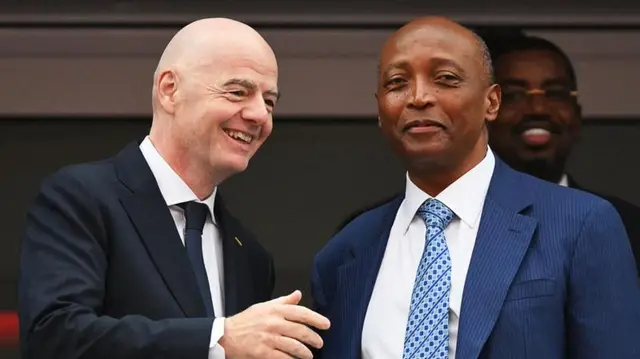
In the row which has engulfed global football and the man who runs it, Gianni Infantino, could Africa end up as a lone voice of support for the Fifa president? While European governing body Uefa has voted to boycott Fifa competitions, including World Cups, if plans go ahead to sell stakes in those competitions to private investors, the Confederation of African Football (Caf) has remained largely silent so far. Much of that has to do with the close relationship between Caf, Fifa and Infantino. Caf president Patrice Motsepe lauded Infantino for his "excellent work" after this year's World Cup and hailed the Swiss as "a good friend". "He is loyal to Africa," Motsepe said on 22 July. "When people have been loyal to you, you never stab them in the back." Fifa's aim is to create a commercial subsidiary to run its main events and allow external investors to buy stakes in it. Caf says its executive committee will meet to "assess and evaluate" the proposal next week, encouraging its member associations to do the same. African countries have already benefited from previous Fifa funding. The new sums at stake could continue to transform the footballing landscape on the continent. Infantino 'wrong man' to lead Fifa says Burnham as criticism grows But given that many African football federations struggle financially, the lure of $40m (£30m) from Fifa may prove enticing to Caf's 54 member associations, especially as an initial $20m (£15m) could be received as early as 1 January – provided the plans are approved by 19 September. "Football is a very expensive venture, especially on the African continent where resources are not easy to come by," Rogers Byamukama of Uganda's football federation told the BBC. "What is wrong with making more money and sharing that money with those that need it most?" However, Isha Johansen, a former president of the Sierra Leonean FA who also served on Caf's executive committee and the Fifa Council, says the proposal "does not sit well". "I think people have got to be really realistic here in knowing where we want to see football going in the coming years," she added. "Should football be commercialised in the manner in which it potentially could be if this proposal were to go through? "As a businessman or woman you want something out of it. You're not just doing it out of generosity. "What price does one have to pay in order to get to this elevated development for football in Africa? I think it's going to take a lot of soul-searching [but] I do hope that they (Caf) go along with all the other confederations." Courting controversy and befriending Trump - the story of Fifa boss Infantino Veron Mosengo-Omba, who served as Motsepe's deputy from 2021 until March this year, was previously chief member associations officer at Fifa - and is a friend of Infantino, having studied law alongside him in Switzerland. Mosengo-Omba was elected head of DR Congo's football federation in May. Together he and Motsepe undeniably improved the financial balance sheet at Caf, not least by improving revenues from the Africa Cup of Nations (Afcon), its flagship tournament, while Infantino has done his part to develop the game on the continent. Africa was the main beneficiary of the expansion of the Fifa World Cup to 48 teams - with the continent awarded a guaranteed nine spots. The previous allocation, five, had long been seen as a slight in Africa. "You need to have a president of Fifa who is as committed to African development and growth as Gianni Infantino is," Motsepe said. "What Gianni has done, to contribute to us increasing the number of African national teams (at the World Cup), [is] enormously important." A lack of financial resources is a big reason for African member associations - many of whom rely on scant government funding - to back Fifa's proposals. "Our government cannot manage to give us even $1m (£740,000) every year for football," Malawi FA president Fleetwood Haiya told Newsday on BBC World Service. "Our government is not able to make sure that they have medical supplies in hospitals [and] at the same time to look at football. "Malawi needs money. Malawi needs stadiums. "I'm 100% in support (of the Fifa proposal). There is no dispute. I don't understand why Fifa took so long to do this." African federations, however, may need to be careful what they wish for, with some people questioning whether governments will continue to fund organisations receiving significant support from elsewhere. Europe, home to the world's biggest domestic leagues, is undeniably where football is most developed and generates the most commercial income. The majority of Africa's top footballers play for clubs there, but the argument is their home countries get little in return. "Uefa is a very rich region," Uganda's Byamukama added. "But how much of their commercial success has been shared with federations that are poor, for instance in Africa, in Asia?" Is Infantino finished? Could Uefa boycott World Cup? What happens now? Cape Verde's impressive debut World Cup campaign came after the Blue Sharks upped their spend on logistical arrangements during qualifying. Haiya says Malawi's performance at the ongoing Women's Africa Cup of Nations, where the Scorchers beat defending champions Nigeria on their debut at the finals, was also built on Fifa funds. "These girls were not given the opportunity or the platform, or they were not supported to showcase their talents. "Gianni Infantino believed in our project for women's football." Byamukama points to money from Fifa helping to fund the construction of Uganda's FA headquarters, a technical centre and a stadium, while a source from another southern African FA said the continent's administrators back Infantino because he has increased financial support. The promise of more to come would only strengthen that bond. "It is a good financial comfort for federations in Africa," the official said. "They can do a lot with grassroots football and infrastructure." However, Caf's close bond with Fifa has had its downsides, with Motsepe appearing unwilling to challenge Infantino or his organisation's decisions in public. Caf did not publicly denounce the world governing body on either issue despite scathing statements from elsewhere. Fifa's expanded Club World Cup, held in June and July last year, meant the 2025 Afcon was forced to move to a December to January slot, causing issues with top European clubs over the release dates for players. And the decision to hold Afcon every four years from 2028, rather than biennially, was seen as a decision that benefits Fifa and the global football calendar rather than Africa. Fifa general secretary Mattias Grafstrom sat alongside Motsepe when the announcement was made. Johansen accepts that the funds from Fifa Forward Enterprise would be a game-changer for many in Africa, but she believes the long-term integrity of the game is under threat. "It is an offer that is hard to refuse," she said. "I think we now come to a point where you really need to know where to draw the line and not sacrifice the beautiful game." Infantino had indicated Fifa's proposals would need a straight majority to go through - meaning 106 of its 211 members need to vote in favour. Should all member associations from those confederations back the stance of their governing body, that would mean 136 nations are already against Infantino's plan. Even if Caf's 54 associations do stand behind the Swiss, the weight of the rest of the world could deny the second-largest and second-most populous continent what many view as a welcome windfall. Additional reporting by BBC Sport Africa's Celestine Karoney.

FIFA.com31 Jul 2026
Fifa says 'nobody selling football' as plan continues

World Cup News

Fifa says 'nobody selling football' as plan continues

Concacaf, which governs football in North and Central America and hosted this year's World Cup, said its 41 member associations also "rejected" the proposal made by Fifa president Gianni Infantino. In a statement released on Friday, Fifa claimed the consultation process had been "disrupted by incorrect media reports". "We respect the feedback and concern aired in public and reaffirm our commitment to an open and democratic consultation," the statement read. "We will proceed with this consultation process to ensure that each MA (member association) has the ability to express its vote based on facts. "Nobody is selling football. This is not something Fifa would ever entertain." Is Infantino finished? Could Uefa boycott World Cup? What happens now? It said it would "invite third parties to make minority, non-controlling investments" in a new subsidiary - Fifa Forward Enterprise (FFE). In a 25-page document created by investment bank JP Morgan, it is made clear that Fifa's tournaments will expand to hit an estimated increased pay-out of 24m euros per member association in the 2035-2039 cycle. It mentions "new business initiatives" and "attracting top talent with incentive-driven compensation". The World Cup is described in it as the "most widely viewed" sporting event but Fifa, by contrast, is said to be "under-monetised". There is no mention in the document of the women's game. On Friday, Fifa said FFE had been proposed "to ensure all Fifa member associations have the opportunity to take meaningful ownership of the commercial opportunity of football in their respective countries". "This does not come at the cost of either the spirit or the governance of Fifa or football itself," it added. Infantino previously wrote to Fifa members saying they will receive $40m (£30m) if they back his controversial proposal. He set a deadline of 19 September for federations to accept his plans if they want to access an initial $20m (£15m). However, Uefa has accused Fifa of using football "to enrich themselves and their friends". If approval is granted, Fifa says Thrive Eternal is expected to lead the proposed investor group for FFE. Thrive is an American venture capital firm founded by Joshua Kushner - the brother of US President Donald Trump's son-in-law Jared. Courting controversy and befriending Trump - the story of Fifa boss Infantino "The World Cup cannot be treated as an investment product," Uefa's statement on Thursday read. "It is one of football's greatest sporting legacies. It has been built over generations by players, national teams and supporters across every continent. "No part of it should ever be surrendered to private investors. The World Cup is not for sale. "This is not merely a profound failure of leadership, but an abdication of Fifa's duty as the custodian of world football." Concacaf said its members "expressed deep concerns about the lack of due process surrounding the proposal" and the "artificially short deadline imposed". It also questioned the need for private investment after what Fifa claimed was the most profitable World Cup in history. The Asian Football Confederation (AFC) said that it is "deeply concerned that Fifa's unilateral actions appear to undermine the very foundations of continental football". The AFC also said it was "unacceptable" that it had not been consulted before the proposal was publicly announced, nor provided with "detailed governance, financial or legal analysis". The governing body overseeing football in South America, Conmebol, is yet to publicly comment on the proposals. The governing bodies in Africa (CAF) and Oceania (OFC) have said they will discuss Fifa's plan in August. Chelsea manager and 2010 World Cup winner Xabi Alonso was asked about the situation during his side's pre-season tour of Australia. "I think that football has to be for the people, not in private hands and I think that the way we love it is this way and we have seen a great World Cup and it's good to defend the interests of all the people," he said. "Hopefully it won't happen and we will do it - we will keep the game as attractive and as authentic as we like it and that's why it creates these emotions, these passions." Chief football news reporterIt feels as though no-one who matters knows how this situation is going to play out just yet. "Not sure the detail was considered when deciding the overall policy," was the response from a senior European football source when asked what this decision means for the U20 Women's World Cup, starting on 5 September, being hosted by Poland and featuring plenty of European nations. Uefa's boycott threat will be activated if Infantino's funding deal is accepted. Given 19 September is the deadline for countries to accept Fifa's deal and bank $20m (£15m) on 1 January, in theory, countries could be pulling out of that tournament in the middle of the quarter-finals and before the semis. After that, the next senior matches in a Fifa competition are the Women's World Cup play-offs in October, which feature England, Scotland, Wales and Northern Ireland among others. Infantino became Fifa president in 2016 when he beat Asian Football Confederation president Sheikh Salman al-Khalifa by 115 votes to 88. The Swiss is due to stand for a fourth term in March. Prior to this week, it had been anticipated he would be re-elected unopposed. FAs around the world, including some in Europe, have already confirmed their intention to support the 56-year-old. But sources say in addition to rejecting Infantino's plan, the vast majority of the Concacaf members are either losing faith in the Fifa president's ability to govern the game, or have lost it altogether. While Uefa members are among the richest on the planet, many nations elsewhere rely on Fifa funding for basic infrastructure. "There are the aspirations and needs of small nations, but you've also got large nations who have the power," former Football Association chief executive Mark Palios told BBC Breakfast. "It's not dissimilar to the attempts to form a European Super League. On one end you've got the people who create the cash, but on the other end you still need competition." Rogers Byamukama of the Ugandan Football Federation argued that any avenue that could lead to more resources for nations like his should be explored. "First and foremost, you need to understand that football is a very expensive venture, especially on the African continent where the resources are not easy to come by," he told Newsday on BBC World Service. "For instance in Uganda, the number of infrastructure projects that have been funded by Fifa from the resources generated by Fifa, especially at the World Cup, both from ticket sales as well as sponsors. "On top of that, there are many grassroot programmes that have been funded by Fifa, including schools for football. "From my perspective, any avenue that brings in more resources is good because those resources would be distributed and given to federations, especially on the African continent and that would inspire growth." Byamukama acknowledged Uefa's right to speak out, but suggested that its members are not reliant on Fifa funding like many associations in the rest of the world where Infantino remains popular. In the first two cycles of the Fifa Forward development programme, through to 2022, $2.8bn (£2.08bn) was made available for investment across the 211 member associations. After being re-elected unopposed in 2019 and 2023, Infantino is expected to win another term in 2027.

FIFA.com31 Jul 2026
Is Infantino finished? Could Uefa boycott World Cup? What happens now?

World Cup News

Is Infantino finished? Could Uefa boycott World Cup? What happens now?

Chief football news reporterPublished30 July 20261655 CommentsUpdated 31 July 2026 The bombshell statement landed at 16:00 BST on Thursday, 30 July. In terms of impact, European football's governing body Uefa could not have gone any bigger. "Uefa and its national associations will not participate in Fifa competitions," it said. Eleven brutal words. The definitive reaction to Fifa president Gianni Infantino's plan to sell a 20% stake in a subsidiary company set up to run the world governing body's competitions, including the World Cup. A company it is intended Fifa will run but that will be part-funded by private investors, including the brother of US President Donald Trump's son-in-law, Joshua Kushner. It feels as though no-one who matters knows how this situation is going to play out just yet. "Not sure the detail was considered when deciding the overall policy," was the response from a senior European football source when asked what this decision means for the U20 Women's World Cup, starting on 5 September, being hosted by Poland and featuring plenty of European nations. Uefa's boycott threat will be activated if Infantino's funding deal is accepted. Given 19 September is the deadline for countries to accept Fifa's deal and bank $20m (£15m) on 1 January, in theory, countries could be pulling out of that tournament in the middle of the quarter-finals and before the semis. After that, the next senior matches in a Fifa competition are the Women's World Cup play-offs in October, which feature England, Scotland, Wales and Northern Ireland among others. "Wales is involved in the play-offs for the Women's World Cup in the autumn, and it would be our first qualification for a World Cup," Uefa vice-president and ex-Wales international Laura McAllister told BBC Radio 5 Live. "Nobody can even countenance the thought of not being involved in those. "But let's be clear here. This is not a problem of Uefa's making. It's a problem that Fifa have created. Nobody wants the players to suffer, and nobody wants nations to suffer when it comes to the most prestigious competitions. "We've been pushed into this corner and that's Fifa's responsibility." Can Infantino survive?No-one can be certain what happens now. And no-one knows what the future for Infantino is. Uefa's statement was followed up by another from Concacaf, which governs football in North and Central America and hosted this year's World Cup, saying their 41 members rejected the proposals. The repeated responses from those who have spoken out are of fury at the lack of proper consultation and lack of dialogue from Infantino, including with his Fifa colleagues, as much as with the proposals themselves. "Anger," said one source, when asked for the prevailing mood at Uefa's emergency meeting. Fifa, meanwhile, has released a new statement claiming consultation over the proposals "was disrupted by incorrect media reports". It added: "We respect the feedback and concern aired in public and reaffirm our commitment to an open and democratic consultation... "Nobody is selling football. This is not something Fifa would ever entertain." Infantino became Fifa president in 2016 when he beat Asian Football Confederation president Sheikh Salman al-Khalifa by 115 votes to 88. The Swiss is due to stand for a fourth term in March. Prior to this week, it had been anticipated he would be re-elected unopposed. FAs around the world, including some in Europe, have already confirmed their intention to support the 56-year-old. But sources say in addition to rejecting Infantino's plan, the vast majority of the Concacaf members are either losing faith in the Fifa president's ability to govern the game, or have lost it altogether. Now there is talk of trying to find someone to stand against him. The name of Nasser Al-Khelaifi has been mentioned. This is understandable. Qatari Al-Khelaifi is already one of the most powerful figures in football, not only through his status as president of back-to-back Champions League winners Paris St-Germain but his leadership of European clubs. Previously known as the European Clubs' Association, Al-Khelaifi took over as chairman in the aftermath of the other seismic event that threatened to pull the game apart - the ill-fated European Super League, which collapsed within 48 hours in 2021. Al-Khelaifi presided over a name change - to European Football Clubs. More importantly, he expanded it to over 800 members. Of the biggest clubs, only Real Madrid remain outside. In theory, he would be the best person to challenge Infantino. But he doesn't want to. "He genuinely, genuinely, genuinely doesn't want the job," was the response of a source close to the 52-year-old when asked about the possibility on Thursday. Historically, sitting Fifa presidents are not challenged in elections. The last president to lose an election was Englishman Sir Stanley Rous when he was beaten by Brazilian Joao Havelange in 1974. "I don't know, in all honesty," said McAllister, when asked if Infantino will keep his job. Former FA chairman David Bernstein was asked the same question by BBC Sport. "In a normal organisation, if he has to back down due to something of this magnitude he'd probably be shown the door," Bernstein said. "But Fifa is not a normal organisation. If he has the support of enough of the national associations, he will continue." Former Uefa chief executive Lars-Christer Olsson told the BBC that Infantino has overplayed his hand and his position could be in trouble. He suggested Fifa should instigate a reform where the presidency circulates around figures from different confederations "rather than giving people so much power" as it has done with Infantino and his predecessors, Switzerland's Sepp Blatter and Brazil's Havelange. When asked if Infantino should be removed from his role, Olsson said: "I think that should be a new start for football." Courting controversy and befriending Trump - Fifa's 'unlikely saviour' In the last edition of the World Cup, the Women's World Cup and the Club World Cup - Fifa's flagship events - Uefa supplied three of the four semi-finalists. If there was no European involvement in a Fifa competition, the commercial impact would be seismic and ensure there was virtually no chance of Infantino hitting the figures he has promised in a letter to the national associations, when he talked about a $40bn (£30bn) product. David Bernstein feels a solution has to be found. "I can't believe in the long term that there will be a schism because it would be a lose-lose for everybody," he said. "Fifa can't afford not to have European nations play in their competitions and frankly Europe can't afford not to be part of it. "On this occasion, Infantino's got to back down. This deal is not acceptable. It's a friends deal and it's not right. If they want to raise capital, there's other, better ways of doing it." Minimum 10-match ban for discrimination - FA McAllister accuses Fifa of 'blackmail' over World Cup plan

FIFA.com31 Jul 2026
Uefa to boycott World Cups if Fifa plans approved

World Cup News

Uefa to boycott World Cups if Fifa plans approved

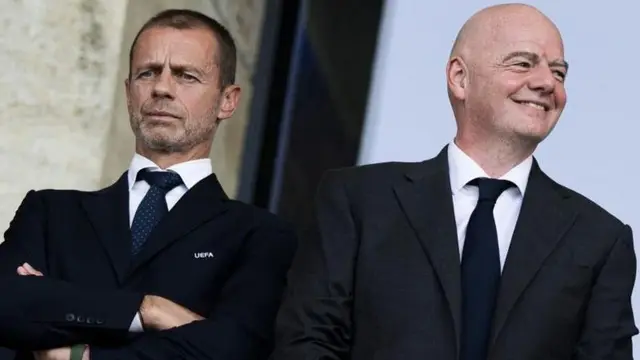
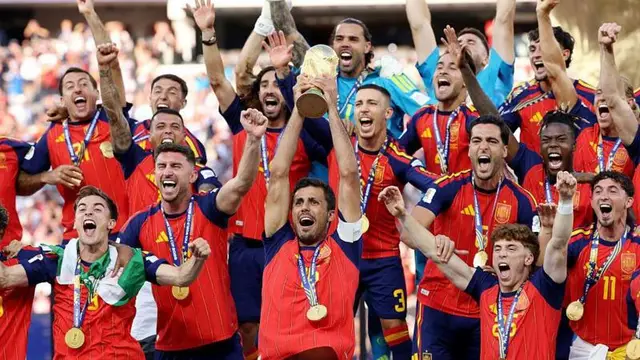
5333 Comments European football's 55 member associations have voted to boycott World Cups if the sport's governing body proceeds with a plan to sell stakes in its competitions to private investors. The decision was made at an emergency meeting called to discuss the proposal announced earlier this week by Fifa, which oversees world football. Concacaf, which governs football in North and Central America and hosted this year's World Cup, said its 41 member associations have "rejected" the proposal made by Fifa president Gianni Infantino, after it met on Thursday. Sources say the Concacaf nations are also losing faith in Infantino. Uefa, which governs European football, had already made its opposition clear by releasing two damning statements - and that strength of feeling has been reaffirmed. "The World Cup cannot be treated as an investment product," it said on Thursday. "It is one of football's greatest sporting legacies. It has been built over generations by players, national teams and supporters across every continent. No part of it should ever be surrendered to private investors. The World Cup is not for sale." Uefa's boycott would cover all Fifa competitions, including the men's and women's World Cups and Club World Cup, and be triggered if Fifa president Gianni Infantino's proposals are voted through by member associations. The first time this stance will be tested at a senior tournament is in October, when the Women's World Cup play-offs are due to be held. It is understood FA chairwoman Debbie Hewitt and chief executive Mark Bullingham were among those to speak during Uefa's meeting, with the atmosphere described as venomous, such was the strength of feeling against the proposals. Despite being one of eight Fifa vice-presidents, Hewitt had no knowledge of the discussions that Infantino had been having regarding the proposals. Is Infantino finished? Could Uefa boycott World Cup? What happens now? It said it would "invite third parties to make minority, non-controlling investments" in a new subsidiary - Fifa Forward Enterprise (FFE). The plan needs to be passed by a vote of Fifa's 211 members. Infantino needs 106 votes in favour for the proposal to go through. Uefa and Concacaf members combined make up 96 associations - of which 90 have a vote and all of them seem set to vote against. Infantino has written to Fifa members saying they will receive $40m (£30m) if they back his controversial proposal. He has set a deadline of 19 September for federations to accept his plans if they want to access an initial $20m (£15m). In a video released by Fifa on Wednesday, Infantino defended the plans, calling them "an offer, not an obligation". If approval is granted, Fifa says Thrive Eternal is expected to lead the proposed investor group for FFE. Thrive is an American venture capital firm founded by Joshua Kushner - the brother of US President Donald Trump's son-in-law Jared. The White House said it had "nothing" to say on Infantino's proposals "at the moment". How has Uefa reacted?In a statement released after Thursday's meeting, which was held virtually and chaired by president Aleksander Ceferin, Uefa said it and its 55 member associations "stand as one". "We unanimously and unequivocally reject Fifa's proposal to transfer ownership interests in the World Cup and other Fifa competitions to private investors," it said. On Wednesday, Uefa had accused Fifa of using football "to enrich themselves and their friends". Its statement on Thursday was even more damning, calling it "irresponsible and indefensible that a proposal of such significance for football was conceived in secret" and "without any meaningful consultation" with those who steward the game. It added: "This is not merely a profound failure of leadership, but an abdication of Fifa's duty as the custodian of world football. "National associations around the world are now presented with an ultimatum: accept the irreversible capture of football's greatest competitions or bear the consequences. "This is not a 'democratic decision', but governance by intimidation - an act of coercion unworthy of an institution entrusted with the stewardship of the global game." While Uefa only accounts for a quarter of Fifa's membership, it does include most of the world's most successful teams. Six of the eight quarter-finalists - including winners Spain - at this summer's World Cup were European. In the 2022 and 2018 editions, the figures were five and six respectively. Of the 23 World Cups to have taken place to date, 13 have been won by European countries. The other 10 have been won by South American sides. The former Wales international told BBC Radio Wales she hoped boycotts would not happen, adding: "I feel optimistic they won't, because the reality is the powerhouse of world football is Europe." Speaking to Radio 4's PM programme, McAllister said there was "real unity" among Uefa members and an "easy consensus over the need to take the strongest possible action given the existential threat that the Fifa proposal poses to our sport". She added: "The reality is we had no choice other than to issue a threat commensurate with this dreadful, catastrophic proposal that has been rushed through with no due diligence, no proper governance and no consultation." She added: "We oppose Fifa's plans - the Fifa World Cup belongs to football and always will." The Scottish FA added its support, saying its board "agrees unequivocally with the concerns raised by all members over the manner in which these proposals have been issued, and deadline set, without a full consultation process or consideration to good governance". Culture Secretary Lisa Nandy said: "This is a principled decision that we strongly support. Football belongs to the fans, not billionaire investors. Enough is enough. It's time to take a stand to protect our game." UK Prime Minister Andy Burnham criticised the plans on Tuesday, saying going ahead with the idea would mean Fifa had "sold out". Concacaf said its members "expressed deep concerns about the lack of due process surrounding the proposal" and the "artificially short deadline imposed". It also questioned the need for private investment after the most profitable World Cup in history, according to Fifa. Concacaf added that it has tasked its Fifa council members with engaging the governing body on how to use existing reserves to fund development across the region and instruct Infantino to ensure proper governance processes are followed. Ronan Evain - executive director of Football Supporters' Europe - told the BBC that Uefa's stance was "very impressive" and a "proper show of force". He added: "It is the response that football needed - it is the response Gianni Infantino deserved." The Asian Football Confederation said it was "disappointed" it had not been consulted before the plans entered the public domain. The Confederation of African Football said its president Dr Patrice Motsepe would host a meeting of its executive committee next week to "assess and evaluate" the proposals. The World Leagues Association (WLA) asked Fifa to withdraw its project and the Premier League, which is a WLA member, said it "wholeheartedly endorses" that view. At this stage, there is a lot we do not know. We do not know what the implications will be for the Women's Under-20 World Cup, which is due to be held in Poland from 5 September - before Fifa's 19 September deadline for associations to claim an initial $20m payment by 1 January. We also do not know what impact Thursday's news will have on Fifa's stated aim to bank the first tranche of 'private investment' cash by the end of October. "I think on this occasion, Infantino's got to back down," former FA chairman David Bernstein told BBC Sport. "This deal is not acceptable. If they want to raise capital, there's other, better, ways of doing it. "In a normal organisation, if he has to back down on something of this magnitude, it would probably mean he'd be shown the door. "But Fifa is not a normal organisation. If he has the support of enough of the national associations he will continue." Without some sort of resolution, Uefa would be outside the global governance of the game. However, Bernstein does not think it will come to that. "I can't believe in the long term there will be a schism because it would be a lose-lose for everybody," he said. "Fifa can't afford not to have European nations play in their competitions and frankly, Europe, also can't really afford not to be part of it." Chief football news reporterThere is no doubt in my mind this story equals that of the European Super League in being the biggest football has had to deal with. Transfers are huge, but ESL and now this go to the very heart of what makes football the game it is and the structures that underpin it. The logical conclusion to the involvement of private investment in Fifa competitions is that, eventually, they will be expanded, both in terms of size and frequency. That squeeze on the calendar would be felt all the way down the pyramids domestically and affect the structure of the game in every single country. Uefa, which has been criticised itself for expanding its club competitions, knows it has the power to stop the Fifa plan. A World Cup without European teams would rob it of three out of four semi-finalists from this summer's competition and six of the eight quarter-finalists. Three of the four semi-finalists in the last Women's World Cup were European. Three of the four semi-finalists in last year's Club World Cup were European. If there are no European participants it is impossible to imagine Fifa generating the amount of revenue commercially needed to pay the sums it is offering. It cannot be overstated how huge this story is. Minimum 10-match ban for discrimination - FA SoundsFifa could receive first external money in October

FIFA.com30 Jul 2026
Alleged assaults and Falklands banner - Argentina face Fifa charges

World Cup News

Alleged assaults and Falklands banner - Argentina face Fifa charges

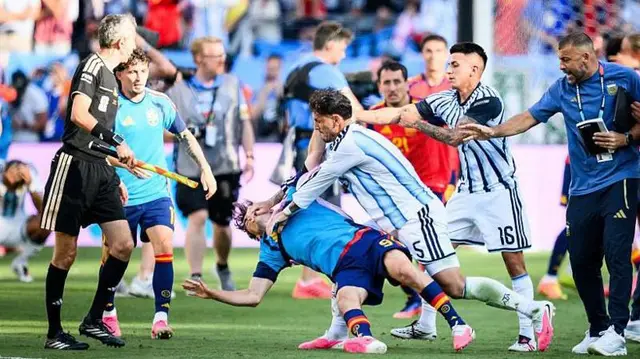
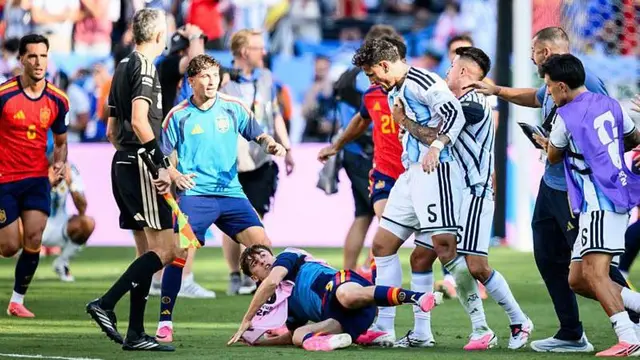
Last week, the world governing body appointed a disciplinary and ethics prosecutor to assess what happened after the final whistle at the New York New Jersey Stadium, with multiple Argentina players and backroom staff involved in altercations with Spain players following their 1-0 loss in July. On the recommendation of the prosecutor, Fifa will investigate Argentina players Nahuel Molina (two counts) and Leandro Paredes (three counts), and Argentina assistant coach Roberto Ayala (one count) for alleged assault under article 14 of Fifa's disciplinary code. Molina may also face disciplinary action for one count of alleged unsporting behaviour under article 14. Team-mate Thiago Almada and Spain midfielder Gavi are also accused of the same breach. Under Fifa's disciplinary code, players and officials face at least a one-match suspension for unsportsmanlike conduct and at least three matches for assault. The latter relates to discriminatory chants and gestures, late kick-offs, the team and spectators displaying inappropriate messages, and spectators throwing objects. Argentina's players celebrated their semi-final win over England with a banner in support of their country's claim to the Falkland Islands. It read "Las Malvinas son Argentinas", which translates as "The Falklands are Argentine".

FIFA.com29 Jul 2026
Fifa offers $40m if nations back controversial plan

World Cup News

Fifa offers $40m if nations back controversial plan

Chief football news reporterPublished29 July 20263160 Comments Fifa president Gianni Infantino has written to all 211 member associations saying they will receive $40m (£30m) if they back his controversial plan to sell off stakes in its major competitions. Infantino has set a deadline of 19 September for football federations to accept his plans if they want to access an initial $20m (£15m). Football's world governing body has said it wants to create a commercial subsidiary to run its main events, including the World Cup, and external investors will be able to buy stakes in it. Uefa, European football's governing body, accused Fifa of using football "to enrich themselves and their friends". The incentive to nations comes less than 24 hours after the bombshell statement rocked football's foundations, quickly leading to condemnation from Europe, Asia and North America. It is understood Infantino even left some of Fifa's eight vice-presidents in the dark about his plan, which it is claimed could raise $10bn (£7.5bn). Infantino has signed a five-page letter, seen by the BBC, outlining the merits of his proposal. The letter states that if member associations respond positively by the deadline, $20m will be "available immediately" from 1 January. In a statement on Wednesday, Uefa said: "We have learned of Fifa's deadline to associations to support their proposals or have the one-off payout offer withdrawn. This says everything you need to know about this plan. "But having held discussions with many stakeholders across the game, Uefa knows there is significant and growing opposition to Fifa's scheme. "Fifa cannot continue to use our sport to enrich themselves and their friends. We can grow the game correctly. "It's time to prioritise associations, clubs, leagues, players and fans." In a video released by Fifa later on Wednesday, Infantino defended the plans, calling them "an offer, not an obligation". "It's part of a democratic process - a consultation process - and, above all, it is an opportunity but not an obligation," he added. "It is a golden opportunity to turbocharge the development of the game globally." Is World Cup sell-off plan a step too far by Infantino? FA 'completely unaware' of proposalsFifa says the money will come from "liquidating a minority portion" of its stake on Fifa Forward Enterprise, a subsidiary company set up to maximise commercial revenue that will include private investors. Although Fifa suggested Infantino gave a broad outline of his proposal at a council meeting just before the World Cup final this month, others who were present rejected this strongly. They say Infantino merely offered an aspirational vision for the future around maximising revenue streams. They now believe they were duped, with the events of the past 24 hours leading them to conclude negotiations have all been completed and now they are being presented with a fait accompli. "It is my duty and responsibility as Fifa president to present such game-changing opportunities to you, our members," said Infantino. "It is equally my duty and responsibility to ensure such proposals are sufficiently complete and feasible, replete with substantiated figures and clear terms to assist you in the decision-making process." Opposition to the plan has been fierce, with many citing the lack of due process as the first point of their anger. A Football Association spokesperson said: "We were completely unaware of this proposal and have no substantive details, including what the proposition actually is and what conditions are attached. "Based on the limited information, we are deeply concerned about the lack of process and governance to get to this point, and the apparent substance and principles involved. "When the proposal is shared in the full and transparent way now promised by Fifa, we will make our views clear and comment further." Former FA and Manchester City chairman David Bernstein said England must "withdraw" from the World Cup if Infantino's proposals go through. "The whole thing is absolutely dreadful," Bernstein told BBC Radio 4's World at One programme. "It's totally unacceptable. It feels [like] cronyism, nepotism. It sort of stinks, frankly." He said that if critics of the plans want to try and save football from this "dreadful situation", they must "have the guts to really follow it through" and refuse to play in the World Cup. It condemned the plans, saying they "crossed a line". It intends to hold an emergency meeting of all 55 members this week to work on a plan of action. Given the strength of feeling, it would be a surprise if the possibility of a boycott was not at least raised. While the confederation only accounts for a quarter of Fifa's 211-country membership, it does include most of the world's most successful teams. Six of the eight quarter-finalists - including winners Spain - at this summer's World Cup were European. In the 2022 and 2018 editions, the figures were five and six respectively. Fifa's argument that it is compelled to look at proposals that would help it grow the game globally has led to fears about expansion at a time when proposals for a 64-team World Cup in 2030, which will be hosted by six countries in three confederations, are gathering pace. That would have huge implications for the football calendar, which is already squeezed, partly because of the expansion of European club competitions. One senior source within the English game told BBC Sport that the threat posed by Fifa's plan is one of the biggest the game has faced and is on a par with the proposed European Super League, which created such controversy in 2021 and was scrapped within 48 hours. It seems unlikely that Fifa will back down in the same manner over this. This latest escalation extends a difficult relationship between Fifa and Uefa, which responded angrily to attempts to host the World Cup every two years when the idea was floated by former Arsenal manager and Fifa's current chief of global football development Arsene Wenger in 2021. Concacaf, which covers North and Central America and hosted this year's World Cup, said in a statement: "We are deeply concerned by the lack of due process. "We share the disappointment of many within our region and the game that this level of detail has been designed and shared publicly before any discussion with the relevant governance bodies and stakeholders has taken place. "As leaders within football, we are the custodians of the game. Collectively, Fifa, the confederations and every member association have a responsibility to always act in the best interests of the sport." The French Football Federation said: "It obviously raises many questions, particularly ‌since we, the member federations, were not involved and we lack the specific information needed to weigh in on matters that are clearly fundamental to the future of football." "It doesn't seem like a reform. It seems like an electoral campaign financed with the future of football," Tebas said. "Development cannot be used to buy votes or silences. The competitions and commercial rights of Fifa are not the personal patrimony of Infantino. "Whoever mixes politics, discipline, money and power without transparency cannot lead anything. "Infantino is not the solution to Fifa's governance. He is the problem." The Asian Football Confederation (AFC) said: "While the AFC recognises the importance of exploring innovative approaches that can strengthen the future of global football, initiatives of this scale and consequence must be founded upon the principles of good governance, transparency and meaningful consultation." Hans-Joachim Watzke, vice-president of the German Football Association (DFB) and president of Borussia Dortmund, told Kicker magazine that Fifa's plans are an "absolute attack on football". He said: "A line has been crossed here. If European football stands united against these plans, that carries a great deal of weight." Infantino's predecessor Sepp Blatter said: "The close relationship between the Fifa president and the US president has reached a financial dimension that is deeply damaging football. No-one has the right to sell our game." European Football Clubs (EFC), an organisation representing more than 850 clubs, said it would have been "appropriate" for Fifa to consult them on "a proposal of such magnitude". It added: "We urge for calm and thorough consultation on all topics affecting the football ecosystem, together with more rigorous and transparent governance processes put in place to protect the game for the long term." The Football Association of Wales (FAW) said it has "not yet received any substantial details from Fifa concerning the reported proposals" and that it "is concerned that such matters have become public prior to being shared with Fifa's member associations". However, there was support for the plan from a Uefa member in the shape of Czech Republic FA president David Trunda. He told Sky News he could "see the pragmatic benefits for Czech football". "Of course we need more details but my personal point of view is that I can see the positive impact of Fifa's intentions," he said. Global players' union Fifpro called on Fifa to "reconsider its proposal without further delay". It said it had "noted with deep concern the proposal to transform the World Cup and other Fifa competitions into investable assets for private capital". It said such a move "would fundamentally and irreversibly reshape the incentives underpinning the competitions" and that it was "particularly troubling that a project of this magnitude has been developed largely behind closed doors" when it had "potentially far-reaching implications for player welfare, the international match calendar and the future governance of the game". The Confederation of African Football said its president Dr Patrice Motsepe will host a meeting of its executive committee next week to "assess and evaluate" the proposals. Infantino's 'time is up' with Fifa - La Liga boss Could Infantino really push through a 64-team World Cup?

FIFA.com29 Jul 2026
Is World Cup sell-off plan a step too far by Infantino?

World Cup News

Is World Cup sell-off plan a step too far by Infantino?

Gianni Infantino is billing it as the democratisation of football. But Fifa's announcement that it aims to sell off stakes in its football competitions - including the World Cup - to private investors via associates of US President Donald Trump has been met with incredulity and rage from fans, politicians and regional governing bodies. The big selling point, according to Infantino, is $40m (£30m) in funding given to all Fifa countries to "develop the game" once the deal is finalised. The Swiss has set a deadline of 19 September for football federations to accept his plans if they want to access an initial $20m (£15m). This is the boldest move Infantino, an administrator who views himself as a world leader on par with presidents and prime ministers, has made in the decade since he became Fifa president. If Fifa pushes the plan through, he will have consolidated his power for the long-term future and made investors wealthy along the way. So why exactly does Infantino feel powerful enough to enact something so controversial, and what could the consequences be? Infantino has enough support to suggest the plan is more likely to go ahead than not. Since being elected Fifa president in 2016, Infantino has earned long-standing, widespread backing from many countries in Africa, Asia, and the Americas, which have gained financially from various policies he has managed. They include the expansion of the World Cup to 48 teams, the growth in commercial and broadcast revenue Fifa has overseen, and a programme which allocates millions in funding directly to member countries every year. That gives him a base of support which constitutes more than half of Fifa's 211 members. The proposal will appeal to many nations, particularly those lower down the football food chain, for whom a £15m windfall would be more than they would ordinarily make over several years. The level of backing Infantino enjoys appears to have emboldened his approach to the presidency. Decisions such as the introduction of hydration breaks and a musical half-time show to the World Cup were taken by his administration without a vote of members, and would have been deemed unthinkable when he took charge a decade ago. And his close relationship with Trump is key too. The investment fund Fifa is dealing with - Thrive Capital - is led by Josh Kushner, the brother-in-law of Trump's daughter Ivanka. The proposal follows years of Infantino making overt attempts to deepen his and Fifa's ties with Trump. He created a Peace Prize and awarded it to Trump. He opened a Fifa office in Trump Tower, New York. He allowed the Club World Cup trophy to be kept in the Oval Office at the White House. He laughed along during Trump's inauguration speech in which he threatened World Cup co-hosts Canada and Mexico. And last week, Infantino heavily mimicked Trump's language when he released a statement describing those who criticised aspects of the organisation of the World Cup as "so consumed by hate and criticism". Working with Trump associates on the plan allows Infantino to harness the power of the bond he has cultivated with the world's most powerful person, with the promise of a mutually beneficial outcome. But while there is a significant element of risk attached to this move, the chances of Infantino being brought down by it are slim, given how strong support is for him elsewhere. He added: "The decision whether or not to proceed with this proposal belongs entirely to you. "In exchange, all that is required is your trust - everything else remains the same." The appeal is clear - vote to help make us richer and we'll make you richer too. But each World Cup makes significantly more money than the last - it will probably be worth far more in four years, and four years after that, than it is now. If Fifa sells stakes now, then the private investors will share in the rewards of that growth in the coming years, rather than Fifa and football doing so alone. And ultimately, Fifa is a non-profit organisation under Swiss law, meaning its ultimate goal is - theoretically, at least - the long-term wellbeing of football rather than making a profit. The big winners from the plan, then, would arguably be some of the smaller football nations, the private investors, and Infantino. "What we know so far about how some national federations spend their money raises a lot of doubts about whether the money reaches the levels of football which Fifa promises," says Miguel Maduro, a former chairman of Fifa's governance committee. Maduro claims he quit that role after 10 months because Infantino and Fifa's wider leadership disagreed with how the committee was operating. "Fifa works as a political cartel - it is fed and supported on a system of patronage, that works through the money Fifa distributes to national federations. There have been cases of corruption," he added. "There is a very high likelihood that this [proposal] will be approved. "It is a form of legalised bribe." BBC Sport has contacted Fifa for comment about Maduro's assessment. Private equity investment has already transformed sports in the USA. Rules have been changed in baseball, basketball, American football and ice hockey to allow for more minority investments in the past decade, causing team values to skyrocket. And La Liga and Ligue 1 have already sold portions of their operations to private equity firm CVC Capital Partners in exchange for an immediate influx of money. Infantino is hopping on a trend in sports economics rather than trying out something entirely new, but stands to further entrench his own power if he succeeds. Why are Infantino and Ceferin in conflict and where could it end?Infantino's proposal has deepened his ongoing conflict with European governing body Uefa - the most powerful and wealthy regional organiser. That followed a series of Uefa announcements making clear it would not follow Fifa policy on controversial issues including dynamic ticket pricing and hydration breaks. One of the cornerstones of the division between the two is that Fifa's revamped and expanded Club World Cup has become a clear, direct threat to Uefa's Champions League. Previously Uefa was the only organisation which ran an international club football competition featuring the best players, watched by billions around the world and generating significant profits. Last summer Fifa muscled in on that elite club football territory, adding teams from other continents to the mix. Some national federations have expressed anger that they found out about the plans only when Fifa made them public, but crucially, many of the statements released so far have not explicitly condemned the concept of the sell-off itself. That said, BBC Sport understands many Uefa members are angry about the plan and that a meeting is set to be convened for them to discuss a response. On Tuesday Uefa said Fifa's plan is "to use our sport to enrich themselves and their friends". Some reports indicate a threat by European nations to boycott the World Cup could be possible. The theory is that a World Cup without European countries would severely compromise the tournament's value to Fifa. But the chances of that coming to pass are debatable. There is also a women's World Cup next year in Brazil, which could be an early target for any action, if Uefa does want to take a bold step of its own. If Ceferin and other European leaders really want to fight Infantino's plan as hard as possible, they must be willing to make a big move of some sort very quickly indeed. For now, Infantino is as emboldened as he has ever been.

FIFA.com29 Jul 2026
Cucurella gets tattoo of Spain coach De la Fuente

World Cup News

Cucurella gets tattoo of Spain coach De la Fuente

367 Comments Spain defender Marc Cucurella has kept his promise to get a tattoo of World Cup-winning coach Luis de la Fuente. Cucurella helped Spain win the World Cup this month as they beat Argentina 1-0 in the final. The 28-year-old, who joined Real Madrid from Chelsea for £52m in June, revealed the tattoo - a portrait of De la Fuente holding the World Cup in front of a number 26 - on social media., external "Promise kept," Cucurella wrote alongside pictures and video of him having the tattoo done. After the final De la Fuente said he expected Cucurella to stick to his word. "I've already told them, 'did you make a mistake?" he joked in his post-match news conference. "They did, but they'll enjoy it. "I'm not so terribly ugly that they will need to put it somewhere nobody can see it. But it makes me laugh and I am proud they keep their promises." Cucurella carried his wife's pyjama top with him as a lucky charm during the World Cup, and recently said he has his trademark long, curly hair so his child can easily keep track of him during matches.

FIFA.com29 Jul 2026
Infantino tells Fifa critics to 'meditate, pray or watch football'

World Cup News

Infantino tells Fifa critics to 'meditate, pray or watch football'

In a 15-slide post on his personal Instagram account - reposted to Fifa's eight million followers - Infantino addressed "those behind their pens and papers, behind their screens" to affirm his belief that, while they were "busy planting seeds of hate", Fifa was delivering the "greatest event on earth". He said the World Cup "celebrated humanity at its best", adding that the 2026 tournament had "100% safety and security, only joy and happiness". Infantino downplayed several of the tournament's high-profile controversies and hailed the involvement of Iran, who featured at the World Cup despite their ongoing conflict with co-hosts the United States, as a success. He said Fifa "worked tirelessly to unite two countries at war", with Iran entering the country "without incident or conflict". His comments are in stark contradiction to those of Iran's head coach Amir Ghalenoei, who said his team were the "most oppressed" at the World Cup. Infantino's 'time is up' with Fifa - La Liga boss They later also encountered restrictions on their movements as they travelled between their training base and group matches in Los Angeles and Seattle. Such issues were not unique to Iran, with fans from Haiti, Senegal, and Ivory Coast impacted by travel bans imposed by the Trump administration, while Somali referee Omar Artan was denied entry to the US - despite holding a diplomatic passport and a single entry US visa - because of his "association with suspected members of terror organisations". Infantino wrote: "You mentioned the few people denied visas and overlooked the millions who were approved, from all parts of the world. Because football unites the world, and it was impressively demonstrated this summer." Doubling down on the tournament's safety, Infantino said there were "zero incidents, zero violence, just joy, emotions, happiness, unity, and togetherness". However, Fifa is investigating Argentina's actions after players and backroom staff were involved in altercations with Spain's players after losing the World Cup final. It is also investigating allegations of racist abuse towards American social media influencer IShowSpeed, while supporters were arrested at multiple matches - including following England's semi-final against Argentina in Atlanta. Immigration and Customs Enforcement (ICE) officials were also controversially present at World Cup stadiums. Infantino also addressed criticism surrounding the standard of officiating at the tournament, in particular concerns about political interference after USA forward Folarin Balogun was made available for their last-16 tie when his one-match ban was suspended by Fifa - following the intervention of US President Donald Trump. Of the 191 other red cards shown at a men's World Cup, only one other player has escaped a suspension. Infantino, however, argued that such decisions are not out of the ordinary, claiming similar rulings are "routine and widely accepted in some of the biggest leagues worldwide". He added: "It's curious that the same countries employing these practices are the ones criticising." The International Olympic Committee has said it will not investigate Infantino for any possible breaches of political neutrality, stating the complaint levelled by human rights campaign group FairSquare falls outside the jurisdiction of its ethics commission. Infantino's advice to his opponents was "to show some love" and "respect" to a tournament where "people came together as families, as fans, as one". "To everyone who missed our beautiful game, the emotions, the celebrations, the laughter, the crying, the deception and the joy. To all of you who missed watching kids, babies, grandparents and parents come together for the beautiful game... sorry that you were so consumed by hate and criticism that you missed it all," Infantino wrote. "While they celebrated, you were busy planting seeds of hate. Our world needs love, not hate; tolerance, not division; celebration, not mourning. "To those spending their time and energy hating us, please take a moment to reflect, meditate, pray or watch a football match and truly observe the faces, the eyes, the emotions. "Because only our beautiful game can deliver such an extraordinary show, a show where everyone becomes one and reconnects as humans. "I am incredibly proud, as Fifa President, to have contributed, even a little, to this show. It's a great feeling." Sports editorIt may be that Infantino's astonishing outburst reflects a genuine grievance he feels about some of the criticism Fifa has faced over its handling of the World Cup. It appears he does not believe the governing body has received enough credit for organising a tournament that enjoyed record ticket sales, entertained many millions, and successfully delivered a huge security operation, despite the tense geopolitical landscape. It also arguably conveys a high degree of confidence in his position and chances of re-election next year, that he feels he can be so defiant. But for many, turning on his critics in such a fashion, and portraying them as negative, biased and unfair 'haters', risks reinforcing an impression that Fifa is unable or unwilling to handle legitimate scrutiny, and is out of touch. The reality is that a host of controversies made such scrutiny inevitable; the issues related to US visa policies, which undermined claims that it would be the most welcoming tournament ever. The unprecedented costs facing fans. The outcry over Fifa's suspension of Folarin Balogun's ban after lobbying by US President Trump, leading to concerns over political interference (regardless of Fifa's denials). The introduction of innovations such as hydration breaks and a 27 minute long half-time show for the final. And the environmental impact of the biggest and longest World Cup ever. Infantino held a media conference on the eve of the tournament - his first for three years - when he told his critics to "chill & relax". Maybe, if he had conducted another one after the event began or once it ended, he could have addressed some of the issues it raised sooner, and not responded in a way that many will see as further evidence of a siege mentality. When the World Cup finishes, the football continues on BBC Sport

FIFA.com27 Jul 2026
From Haaland love to Mexico’s Merlin: 26 memories from the 2026 World Cup

World Cup News

From Haaland love to Mexico’s Merlin: 26 memories from the 2026 World Cup

Norway’s striker left his mark, as did Scotland’s fans in Boston, but Turkey’s dark horses fell at the first hurdle “I played with him on my PlayStation, and now I’ve scored against him,” Livano Comenencia said after converting Curaçao’s first World Cup goal past Manuel Neuer in their opening match against Germany. The smallest nation ever to qualify for the World Cup went on to lose 7-1 but that goal – their only one of the tournament – will go down in history. Should Jude Bellingham’s first goal against Norway have been ruled out? Perhaps so given the ball appeared to hit an overhead cable in the buildup. Fifa insisted there had been no such intervention; Norway’s manager, Ståle Solbakken, was sure there had been. “Many on the bench reacted immediately … the ball fell down straight in front of us,” he said, furiously. “I’d rather be us than them,” said Jesse Marsch after Canada were comprehensively beaten by Morocco in the last 16. “It takes some nerve to say that when you lose 3-0,” said Morocco’s head coach, Mohamed Ouahbi, in response. Marsch also somewhat hilariously overestimated the capacity of BC Place after his side’s 6–0 win over Qatar, saying: “There’ll be 60 million people that said they were here.” Between 1978 and 2018, only the original Ronaldo had scored more than six goals at a single World Cup (eight in 2002). Lionel Messi and Kylian Mbappé had matched the Brazilian’s tally by the semi-finals this time around, with Mbappé winning the Golden Boot after scoring two goals against England in the third-place playoff. ‘CR7’ finally ended his knockout goal drought against Croatia as Portugal squeezed into the last 16. However, joy soon turned to despair when Portugal were eliminated by Spain in the next round. Ronaldo struggled to have any impact on proceedings, managing only 19 touches in what was his final World Cup match. “I gave it all, I gave it my best,” he said afterwards. The mistaken identity rule was updated for this World Cup to cover situations where a player was booked but the offence was committed by the other team and well and truly took effect during Argentina and Switzerland’s quarter-final in Kansas City. The referee, João Pinheiro, initially issued Argentina’s Leandro Paredes a yellow card for his challenge on Switzerland’s Breel Embolo before the VAR called him to the monitor. Embolo was then ruled to have dived and was punished with a yellow card himself – it was the forward’s second of the game and he was duly sent off. “This rule destroyed the game today,” said Switzerland’s head coach, Murat Yakin, after his side’s 3-1 loss. Competing against the backdrop of their country’s conflict with the US, Iran’s players faced incredible difficulties before a ball was kicked. With their training base abruptly switched from Arizona to Mexico before the tournament, the team were then only allowed to enter the US the day before their first two matches and had to leave immediately after. Despite that, they only narrowly missed out on the knockout rounds after Austria and Algeria drew 3-3 in the final round of the group stage to send them home on goal difference. “What these players have done should be written in history because the host country treated us very unfairly,” Iran’s head coach, Amir Ghalenoei, said. Snapchat stories. Stuffed raccoons. Doing next to nothing against Brazil for 79 minutes and then scoring twice in 11 minutes. It’s fair to say Erling Haaland made his mark at the World Cup. “When someone asks me what my biggest fear is but I can’t say being charged at by Haaland at full speed so I just say spiders,” reads a video that has racked up millions of views on Instagram, a reference to how Haaland chased down Iraq’s goalkeeper, Jalal Hassan, for his second goal of the tournament. Turkey were tipped to go far but, in the end, didn’t even make it out of the group stage. Indeed, they were the second country eliminated from the tournament following back-to-back losses to Australia and 10-man Paraguay. “We should have won these games … everybody’s sad, everybody’s crying,” said Arda Guler, Turkey’s wonderkid after his country’s less-than-wonderful showing. “I’m going home and won’t be watching any more games from the tournament,” said Egypt’s head coach, Hossam Hassan, after his side’s loss to Argentina in the last 16. “What happened to us wasn’t fair. We should have had a penalty, a goal was disallowed and I don’t know why.” Hassan was not alone in thinking crucial decisions had favoured the world champions in what was arguably the game of the tournament in Atlanta. It started off as a standard submission for the World Cup’s official track list but was quickly adopted by England’s travelling support as the theme song of their tournament run, Oasis’s 1995 classic creating a genuinely uplifting bond between plays and fans. Harry Kane went as far as describing the post-match ritual of standing alongside his teammates, arms around each other’s shoulders, and facing a wall of happy, singing English faces as one of his “favourite ever moments in an England shirt”. Lamine Yamal had a great World Cup but not as great as his three-year-old brother, Keyne, who captured hearts worldwide with his wide-eyed, big-grinned expressions of delight whenever his older sibling shone at the tournament. A young star was born on the back of another young star and both look here to stay. Merlin the duck became a sensation after being spotted at Mexico’s post-game celebrations following their opening World Cup win over South Africa. Indeed, Merlin became so famous that he was granted a meeting with Mexico’s president, Claudia Sheinbaum. “We feel very honoured to be here with the president, it is an honour for us to stand before you and for the whole world to see the beautiful side of Mexico.” said Karla Gómez, Merlin’s owner. Sadly, Merlin was unable to watch Mexico in the flesh due to Fifa regulations. Messi, Mbappé, Haaland, Harry Kane … this has been a World Cup of goalscoring superstars well and truly coming to the fore, and then there has been Mikel Merino. The Spain midfielder came off the bench to score crucial winning goals against Portugal and Belgium in back-to-back knockout games. It was some contribution from the Arsenal player to his country’s World Cup triumph. “Gordon!” shouted Javier Aguirre at England’s left-sided forward during the first-half hydration break of an epic last-16 encounter at the Azteca, followed by something indistinguishable when Anthony Gordon turned back to look. Keen-eyed internet users later deciphered it as a very cheerful “fuck you!” from Mexico’s manager, with both men subsequently laughing with delight. “I’d just run the full-back down the line,” Gordon said after England’s 3-2 win. “So I took it as a bit of a compliment from him.” After being named player of the match in Cape Verde’s opening goalless draw with Spain, Vozinha teared up. “My mum didn’t manage to be here because of the visa,” said the 40-year-old goalkeeper. Two days later the House Democratic leader, Hakeem Jeffries, announced that arrangements had been made to waive the cost of Ana Évora’s visa; she was subsequently in attendance as her son played in a 2-2 draw with Uruguay and became one of the stars of the tournament. Neil El Aynaoui struck the crossbar. Justin Kluivert’s effort ricocheted off a post. Bart Verbruggen almost saved Soufiane Rahimi’s strike but helplessly watched it squirm under him and into the back of the net. At 2-2, Quinten Timber put his shot well wide, handing Morocco the advantage only for Achraf Hakimi to do the exact same thing. Standing bolt upright, Yassine Bounou saved from Crysencio Summerville before Ismael Saibari put an end to the rollercoaster of a truly remarkable last-32 penalty shootout. “I’m begging Fifa to change the position of the photographers in the national anthem, because I could not see my team,” Thomas Tuchel said after England’s opening win against Croatia. “It was a very special moment, and I was standing in front of a wall of 50 photographers and I could not see one single player.” It wasn’t the first time at the tournament that England’s head coach made his frustrations clear. Mexico’s 2-0 win over South Africa kicked off the World Cup and simultaneously almost equalled the 2022 tournament’s tally of red cards in a single match. Yaya Sithole capped off a terrible second half for South Africa by getting sent off just after the break before his teammate Themba Zwane and Mexican defender César Montes were shown red cards within eight minutes of each other. With the vast majority of the football world rooting for them, Belgium reacted to the suspension of Folarin Balogun’s ban for the USA’s last-16 encounter with the Red Devils in Seattle with a ruthlessly commanding performance. They beat the co-hosts 4-1 and marked the victory with a string of celebrations that made clear what they thought of the controversy surrounding’s Balogun’s presence on the pitch, including an imitation of Donald Trump’s dance moves in the dressing room afterwards and a gleeful tweet from the team’s official account that simply read: “Overturn this.” There was widespread delight when Paraguay eliminated Germany in the last 32 with a show of togetherness and defiance but their popularity diminished during their subsequent defeat by France on the back of a brutal display of the dark arts. Joe Hart brandished the South Americans an “absolute disgrace” while his fellow BBC pundit Micah Richards thought that the approach was wholly unnecessary, saying: “Paraguay are better than that. Defensively they were so good and they didn’t need to get into these antics.” The Uzbek referee, Ilgiz Tantashev, also faced intense criticism after inexplicably failing to book any Paraguay players. After Kylian Mbappé scored the first of his two goals against Sweden, he and his teammates ran over to Didier Deschamps and hugged their head coach. The gesture was a response to Deschamps’ return to the touchline following the death of his mother. When asked about the embrace, Mbappé said: “That’s the DNA of this group. The coach has been through certain circumstances, and we’re all with him and will continue to support him.” In a bizarre twist, the USA’s 2-0 victory over Australia in the group stages had to be stopped for, and not by, the referee, Felix Zwayer, after he collapsed with cramp in the dying minutes of the contest in Seattle. Australia’s midfielder Aiden O’Neill and the USA’s Balogun helped Zwayer stretch out the cramp amid ironic cheers from the crowd. Croatia had seemingly rescued their World Cup campaign from the jaws of defeat after Josko Gvardiol tapped in at the back post in the final stages of their last-32 encounter with Portugal in Toronto. But then VAR got involved and the goal was ruled out after Fifa’s sensor technology discovered that the cross to Gvardiol had taken the faintest touch off the head of Igor Matanovic. “It was very bad refereeing,” said Croatia’s manager, Zlatko Dalic. “I’m not saying that sometimes VAR can’t be of help, but it kills the emotions, it kills everything.” Jayden Adams, who featured in all three of South Africa’s group games, passed away just days after returning home from North America. “Today, South African football mourn the loss of a talented player whose passion, dedication, and love for the beautiful game inspired many,” read a national team tribute. A minute’s silence was observed before all quarter-final matches, alongside an outpouring of touching tributes to the 25-year-old midfielder.

FIFA.com25 Jul 2026